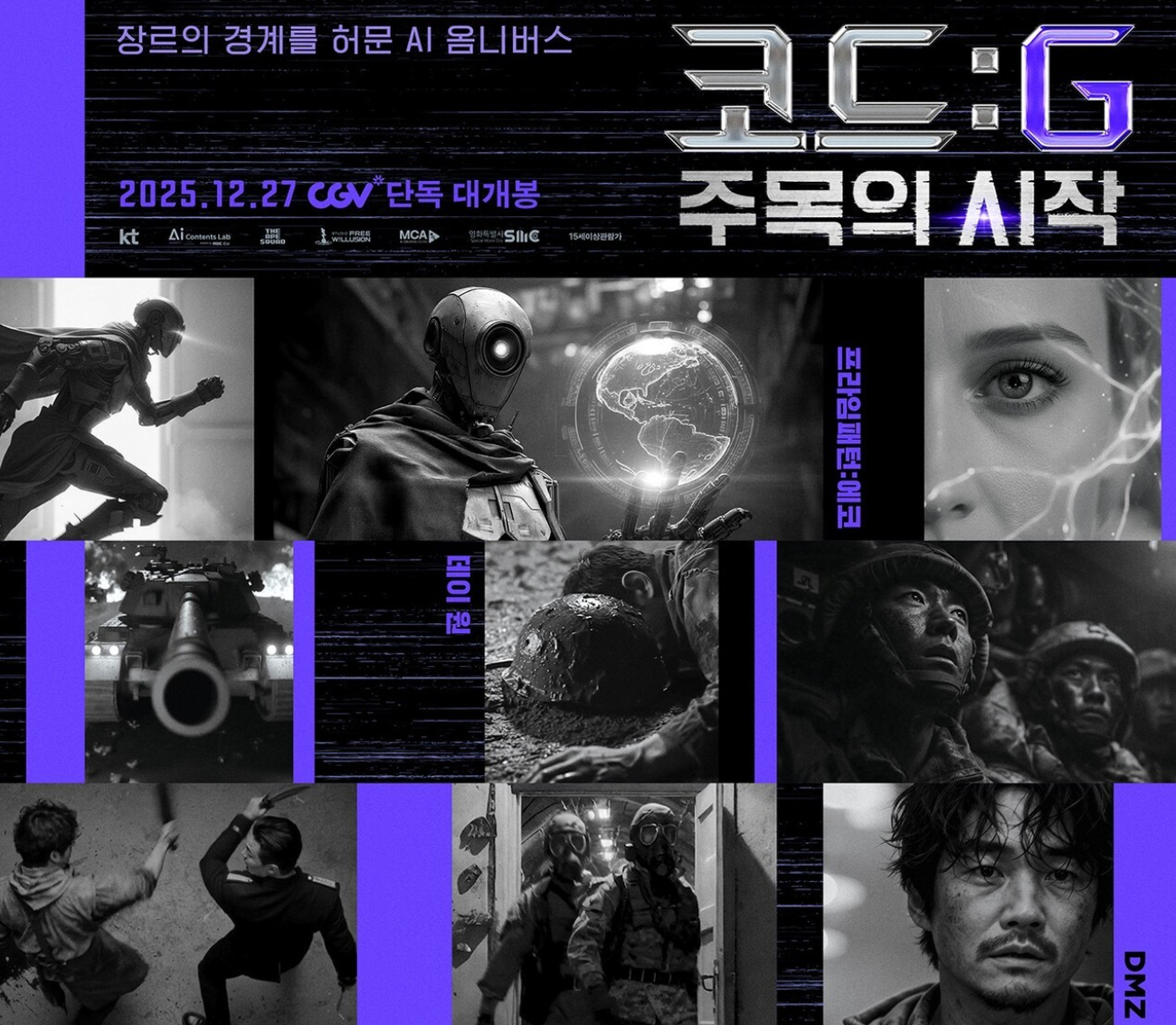
KT has announced the theatrical release of Code:G – The Beginning of Attention, marking the first commercial film in South Korea created entirely using generative AI and released in cinemas. The film will open exclusively at CGV theaters on December 27, requiring paid admission like any conventional commercial release.
While AI-assisted production has been used in films before, this project represents the first case in Korea where AI was responsible for generating 100% of the visual content for a theatrical feature, signaling a potential inflection point in media production.
A Commercial Experiment in Fully AI-Driven Cinema
Code:G – The Beginning of Attention is an omnibus-style film composed of five independent short stories, unified under the theme of humanity in the age of artificial intelligence. The project was jointly planned and funded by KT, with distribution handled by KT Studio Genie.
According to KT, the film was developed as part of the company’s broader AI-driven media and content strategy, with research and development personnel from within the KT Group directly participating in the planning process.
The production studios were selected through KT’s “Biz Collaboration” program, which supports emerging small and venture content creators.
Directors, Structure, and Production Approach
The omnibus consists of works directed by six filmmakers:
- Jusin Kim (Prime Pattern: Echo)
- Younggi Kim (Memory Management Bureau)
- Hansol Kwon & Giseon Hong (DMZ)
- Youngyoon Song (Order in Chaos)
- Kwangsik Kim (Day One)
Most segments were produced without any live-action filming, relying solely on generative AI to construct characters, environments, and narrative sequences.
One segment, Memory Management Bureau, adopts a hybrid approach, combining the performance of actress Lee Sun-bin with AI synthesis technology for more than 90% of the visual composition. All other segments were created entirely through AI-generated imagery.
KT stated that each film took approximately one to two months from initial concept and script development to final production, highlighting the speed advantages of AI-based workflows.
Audience Reception and Industry Dialogue
Ahead of its official release, the film was screened on December 23 at CGV Yongsan I’Park Mall, followed by a Director’s Talk (GV) session. Around 300 attendees, including university students, aspiring AI filmmakers, and participants from KT’s AI education programs, took part.
According to KT, audience reactions were largely positive, particularly regarding:
- The novelty of AI-generated films being screened in theaters
- The experimental nature of the visuals
- The overall level of narrative and technical completeness
During the discussion, directors addressed the limitations of current AI tools, production challenges, and the creative opportunities AI enables—especially for scenes that are difficult or costly to realize using traditional filmmaking methods.
Several directors emphasized that AI functioned not as a replacement for human creativity, but as a tool that expands expressive range and lowers barriers to experimentation.
KT’s Strategic Perspective
KT views Code:G – The Beginning of Attention as a market test for the commercial viability of generative AI films. The company plans to analyze audience response and box-office data before determining whether to pursue further AI-based film productions.
Kim Chae-hee, Executive Vice President and Head of KT’s Media Division, stated:
“This project demonstrates how AI can lower the entry barriers to creative production and enable broader experimentation within the industry. Even with current technical limitations, documenting this stage of AI filmmaking has significant value. It can serve as a reference point for future discussions on creative methodologies.”
She added that KT aims to position itself as an AICT (AI + ICT) media company, supporting emerging AI creators and connecting experimental projects to commercial distribution channels.
Why This Matters
The release of Code:G – The Beginning of Attention represents more than a technical showcase. It raises fundamental questions about:
- The role of AI in creative authorship
- The economics of content production
- Audience acceptance of AI-generated storytelling
- The future relationship between human creators and generative systems
As AI-generated content increasingly enters mainstream distribution channels, KT’s experiment may serve as a benchmark for how AI cinema transitions from novelty to industry practice.
About the Author

AI FOCUS에서 더 알아보기
구독을 신청하면 최신 게시물을 이메일로 받아볼 수 있습니다.