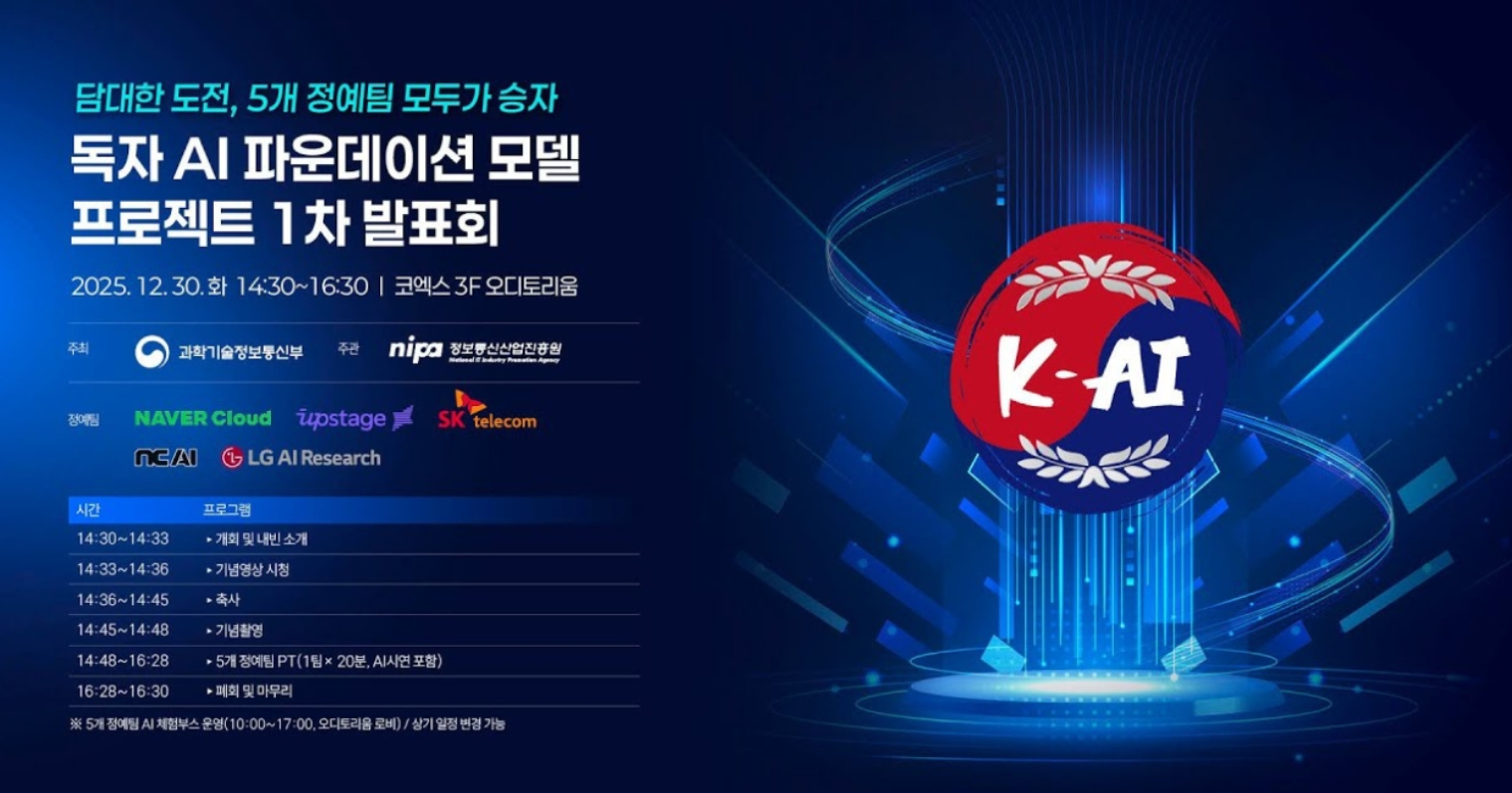
South Korea has officially begun its high-stakes survival audition to crown the “National Representative AI.” The first-round results, recently released by the Ministry of Science and ICT (MSIT), have sent shockwaves through the industry as tech giant Naver Cloud failed to make the cut.
Here is an in-depth look at the background of this project and why “Technical Sovereignty” changed the leaderboard.
1. Project Background: Why Do We Need a “National Representative”?
This project is not merely about funding a high-performing AI. It is a strategic move to secure “Sovereign AI.”
- The Goal: To reduce dependence on U.S. and Chinese tech giants (like OpenAI or Google) and develop a foundational model that perfectly understands Korean language, culture, and legal nuances.
- Government Backing: Selected teams receive unprecedented support, including access to hundreds of NVIDIA H100 GPUs—the “digital gold” of the AI era—along with massive datasets and R&D funding.
- The Format: A two-stage survival competition. The first stage verifies the core technology, while the second stage focuses on scaling and sophisticated “Foundation Model” development.
2. 1st Round Results: An Unexpected Turn of Events
The MSIT announced the results on the 15th. While the original plan was to eliminate only one team, the ministry tightened the criteria and excluded two teams, leaving only three elite finalists.
🏆 The Finalists (3 Teams)
- LG AI Research: Secured 1st place across all categories, including benchmarks, expert reviews, and user satisfaction. Their “EXAONE” model was praised for its high degree of completion.
- SK Telecom: Recognized for its robust data infrastructure and the proven technological prowess of its “A. (A-Dot)” service.
- Upstage: A leading AI startup that proved it could compete with conglomerates through world-class fine-tuning capabilities.
❌ The Eliminated (2 Teams)
- Naver Cloud: Despite being the operator of “HyperCLOVA X” and a pioneer in Korean AI, their elimination was the biggest upset of the round.
- NC AI: While leveraging AI expertise from the gaming industry, the team fell short in quantitative performance benchmarks.
3. The Deciding Factor: “Technical Originality”
The reason for Naver Cloud’s exit wasn’t a lack of performance—it was a failure to meet the strict “Originality” (Technical Sovereignty) threshold.
- The Open-Source Controversy: It was revealed that certain components of Naver’s model (specifically the ‘Vision Encoder’) were based on Qwen, an open-source model from China’s Alibaba.
- The Ministry’s Stance: The MSIT maintained that a “National Representative” must be built on 100% proprietary technology, from architectural design to final training. If the core engine relies on foreign open-source code, it cannot be considered a guardian of national AI sovereignty.
4. The Roadmap and Key Watchpoints
The government is now moving quickly to reorganize the project and fill the vacancies left by the eliminated teams.
- New Recruitment: The MSIT will open a new public call to select one additional team, aiming to maintain a four-team structure for the second stage.
- GPU Powerhouse: Finalists in the second stage will be allocated 500 GPUs per team, a massive computing resource rarely accessible to individual private companies in Korea.
🧐 What to Watch For
- Naver’s Redemption: Will Naver Cloud return to the competition with a 100% proprietary model to reclaim its pride?
- LG’s Dominance: Can LG AI Research maintain its lead and evolve “EXAONE” into a global-tier model capable of rivaling GPT-4?
- Real-World Impact: By the time the AI Basic Act is enforced in 2026, will these “National Representative” models be ready to drive actual value in Korean industries?
Closing Summary This selection process serves as a declaration that South Korea will not settle for being a “consumer” of AI but intends to “own” the root technology. The sting of elimination and the heat of competition are the birth pains of a truly independent K-AI ecosystem.
About the Author

AI FOCUS에서 더 알아보기
구독을 신청하면 최신 게시물을 이메일로 받아볼 수 있습니다.