The Korean AI industry has reached a critical inflection point. SK Telecom has unveiled A.X K1, a large language model with 500 billion parameters, marking the largest AI model ever developed domestically. More than a record-setting announcement, this launch reflects how Korea is redefining its position in the global AI landscape.
A Strategic Choice in Global AI Competition
The global AI race is currently dominated by a handful of Big Tech companies. OpenAI, Google, and Meta continue to scale their models with massive capital and infrastructure advantages. Against this backdrop, SK Telecom’s approach stands out.
A.X K1 is not positioned as a direct competitor in a pure parameter arms race. Instead, it represents a strategic commitment to a sovereign AI foundation model. By explicitly framing the project as part of Korea’s ambition to join the “global AI top three,” SK Telecom elevates this model beyond corporate R&D into a national-level technological statement.
Why Structure Matters More Than Size
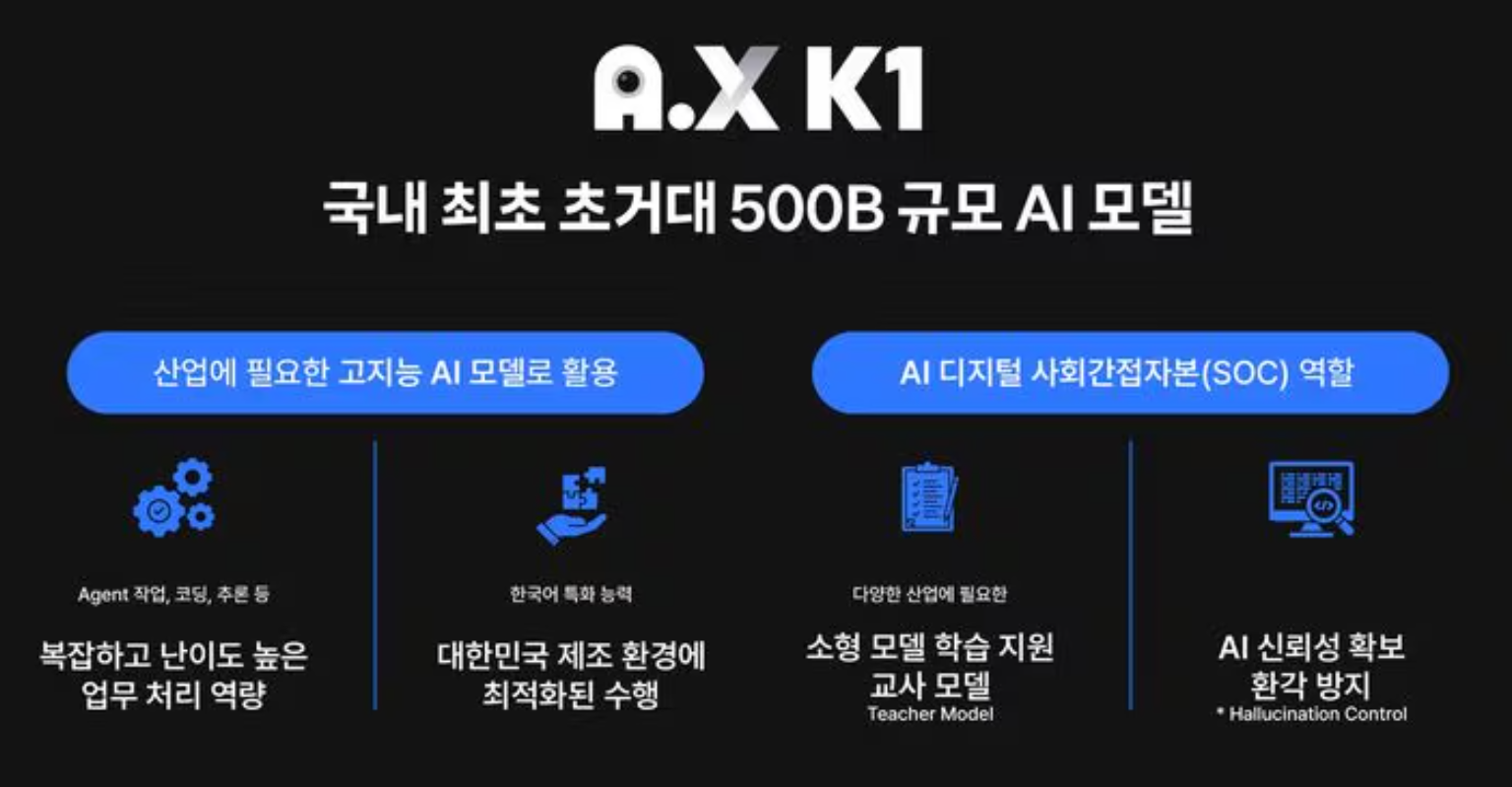
A.X K1 consists of 519 billion parameters, but its significance lies in its architecture rather than its scale alone. The model adopts a Mixture of Experts (MoE) design, in line with recent global trends.
During training, the model leverages up to 685 billion parameters. However, when responding to user queries, only about 33 billion parameters are activated. This selective activation allows A.X K1 to balance high performance with computational efficiency, addressing one of the most persistent challenges of large-scale models.
Another notable feature is its role as a teacher model. Through knowledge distillation, A.X K1 is designed to transfer capabilities to smaller models under 70B parameters. This positions it not merely as a service model, but as a foundational engine intended to strengthen the broader Korean AI ecosystem.
From Research to Real-World Deployment
A.X K1 is not confined to laboratory experimentation. Approximately 20 organizations, including SK hynix, SK Innovation, and SK Broadband, are already participating in on-site deployments. Applications span telecommunications, semiconductor manufacturing, energy, and industrial automation.
This simultaneous transition from model release to industrial application highlights a key shift: foundation models are no longer abstract research artifacts. They are becoming operational tools embedded directly into production environments.
SK Telecom has also indicated future expansion toward manufacturing AI, humanoid robotics, and on-device AI, signaling that A.X K1 is intended as a long-term infrastructure layer rather than a one-off model release.
An AI You Can Actually Experience
One of the most distinctive aspects of this launch is accessibility. A.X K1 will be integrated into SK Telecom’s AI service, A-dot, making it available through voice calls, messaging, web, and mobile applications. The company also plans to release APIs and open-source components, reinforcing its “AI for all” narrative.
During public demonstrations, the model showcased advanced reasoning capabilities, including mathematical problem solving, complex inference, and high-level coding tasks. These demonstrations underscored a critical point: A.X K1 is not a distant vision of AI, but a system users will soon interact with directly.
A Test Case for Korea’s AI Future
A.X K1 represents both a technological achievement and an experiment. It tests whether a large-scale model, trained from the ground up on Korean language, culture, and institutional context, can carve out meaningful relevance in a global AI ecosystem dominated by foreign platforms.
Whether A.X K1 becomes a global benchmark or remains a domestically optimized foundation model remains to be seen. What is clear, however, is that this project signals a shift in posture. Korea is no longer positioning itself solely as an AI adopter, but as a country attempting to design its own foundational AI structure.
The real verdict will not come from benchmarks or press releases, but from how effectively this model performs in real-world environments. That evaluation has already begun.
About the Author

AI FOCUS에서 더 알아보기
구독을 신청하면 최신 게시물을 이메일로 받아볼 수 있습니다.